Flow + Realization
Flow + Realization is a leadership operating idea that connects how work moves through a technology organization with whether that work produces the outcomes it was funded for. Flow asks: how is the work moving? Realization asks: did it produce the outcome we expected? Most organizations measure the first and assume the second.
The short version of the whole idea fits in one line: work has to move, and it also has to matter. Shipping on time is evidence of flow. It is not evidence of value.
What Flow measures
Flow is about making invisible work visible. Where does work wait? Where does it bounce between teams? How predictable is delivery once something is started? Flow metrics such as lead time, waiting time, and delivery predictability tell you whether your system of work moves value steadily or relies on heroics.
This part of the model stands on well-established ground, and the book credits it that way: value stream management, the Flow Engineering work of Steve Pereira and Andrew Davis, and the DORA research program described in Accelerate by Nicole Forsgren, Jez Humble, and Gene Kim. Profitable Engineering does not claim to have invented flow measurement. Its contribution is what comes next: pairing flow with an explicit discipline for outcomes.
What Realization asks
Realization starts before the work does. For any significant investment, the anticipated outcome gets written down first: what customer behavior, operational result, or financial change do we expect this work to produce, and by when? After release, the question is asked again with evidence. Did customer behavior change? Did the operational numbers move? Did the financial result appear?
That is why "shipped" is not "done." A feature that delivers on schedule and changes nothing has cost money and realized nothing.
Two completion checkpoints
The practical mechanism is a pair of checkpoints. Checkpoint one: the work is delivered. Checkpoint two: the realization review has happened, on a date set in advance, typically 30, 60, or 90 days after release depending on how quickly the outcome could plausibly show up. An initiative is only complete when both have occurred. The second checkpoint is the one most organizations skip.
The realization practice in depth, including the review routine, leading versus lagging signals, and a worked example, is covered on the Outcome Realization page.
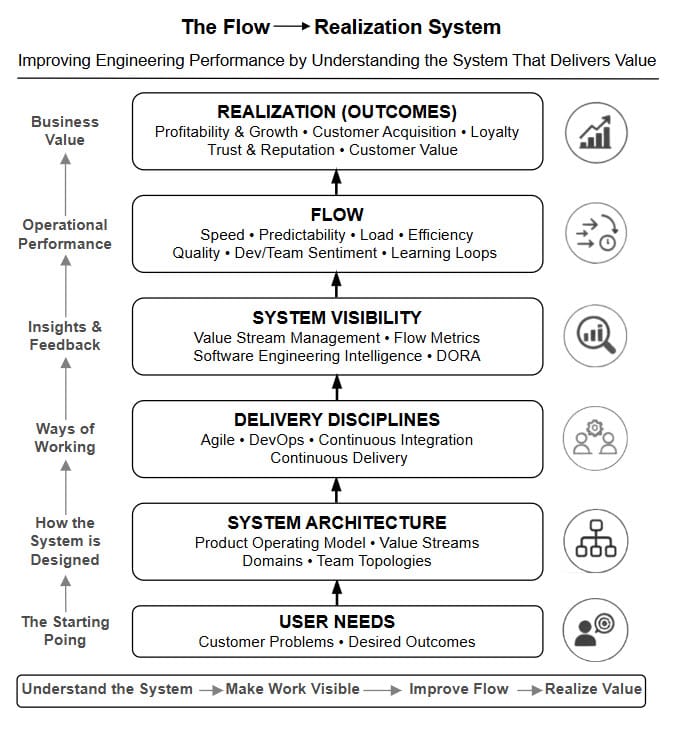
This and the book's other diagrams are shared on the figures page so they are easy to read at full size, including The Scope of Measurement and the Outcome Lifecycle for a Major Initiative.
A worked example
A product team proposes a self-service onboarding flow. Before work starts, the anticipated outcomes are written down: reduce time-to-first-value from 14 days to 5, and cut onboarding support tickets by 30 percent, measured 60 days after release.
The team delivers on schedule. Checkpoint one is met, and in most organizations the story would end there as a success. At the realization review 60 days later, time-to-first-value sits at 8 days and tickets are down 18 percent. Real movement, partial realization. Now leadership has an actual decision to make with actual evidence: invest further to close the gap, accept the partial result and move on, or dig into why the remaining friction exists. Any of those can be right. What is no longer possible is assuming the outcome happened because the feature shipped.
What this can and cannot tell you
Honest limits matter more here than enthusiasm. Attribution is rarely clean: markets shift, seasons change, and other initiatives land in the same window. A realization review produces evidence, not proof of causation. Small samples are directional. Leading indicators are hints, not outcomes. The discipline is valuable precisely because it replaces assumed success with examined results, including the uncomfortable ones.
Flow + Realization is developed in full in Profitable Engineering: Transforming Technology Teams into Strategic Business Partners by Phil Clark, with chapters on funding models, measurement, and responsible AI adoption. The book is available in paperback, hardcover, Kindle, and audiobook.