AI and Software Delivery
AI will amplify whatever system it touches. Strong systems gain leverage. Weak systems gain noise. That single idea does more work than any adoption statistic: AI in software delivery is a systems question before it is a tooling question, and the organizations that benefit are the ones whose delivery system was worth amplifying.
This page makes no universal productivity promises, because there are none to make. What it offers is the operating logic: where the constraint actually moves, what to invest in, who owns decisions, and how to know whether an AI investment produced anything.
Throughput stops being the constraint
AI assistance makes generation fast: more code, more drafts, more proposed changes per week. Nothing about that speeds up code review, testing, integration, security evaluation, or the human decisions in between. When one stage of a system accelerates and the rest does not, the constraint moves downstream and work piles up in front of it. That is a flow problem, and the flow lens applies to it exactly as it does to any other bottleneck.
Verification capacity is the investment
More code is not more value; verified, integrated, operating change is. So the deliberate leadership move is funding the verification side of the system to match the new generation rate: review standards and reviewer time, test infrastructure that can keep pace, provenance for generated changes, and observability that catches what review misses. A team that doubles generation without touching verification has not bought speed. It has bought a longer queue.
Humans own the decisions
Responsible adoption rests on one operating principle: people own every decision with consequences. What ships, what is secure enough, what the customer experiences, what gets rolled back. AI drafts, suggests, and accelerates; it does not own outcomes, and an organization that lets accountability blur into its tooling will discover the gap during its first serious incident. This is an operating principle, not a compliance disclaimer.
Measure AI investments by outcomes
AI spending deserves the same discipline as any other investment: an anticipated outcome written down before rollout, and a realization review after. The useful outcomes are delivery and business results: cycle time, defect escape rate, cost-to-serve, incident load. "Percent of engineers using the tool" is an adoption number, not an outcome, and celebrating it is how AI programs become vanity programs.
A worked example
A platform group rolls out an AI coding assistant with a written anticipated outcome: reduce change cycle time by 20 percent within two quarters. Pull request volume rises quickly and visibly, and the program looks like a success. At the realization review, cycle time has not moved: the gain was absorbed by a growing review queue, and reviewers report spending more time per change, not less. The follow-up investment goes into review capacity and verification tooling rather than more licenses. The next review shows cycle time improving. None of that required hype; it required treating AI like an investment in a system.
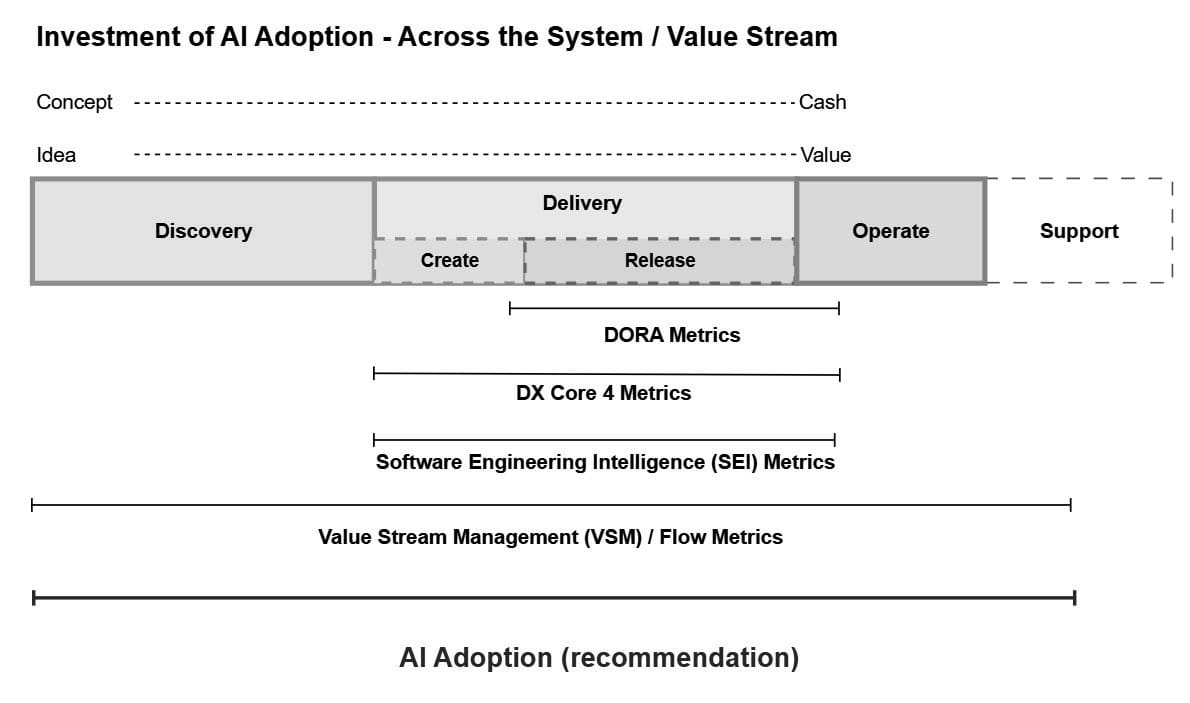
This and the book's other diagrams are shared on the figures page so they are easy to read at full size, including The Vibe Coding Workflow and The Value Stream Convergence Model.
Responsible AI adoption, from the operating principles to the measurement discipline, is developed in full in Profitable Engineering: Transforming Technology Teams into Strategic Business Partners by Phil Clark. The book is available in paperback, hardcover, Kindle, and audiobook.