Outcome Realization
Outcome realization is the practice of writing down the outcomes an investment is expected to produce before the work starts, then reviewing the actual outcomes after release, on a date chosen in advance. It is the second half of the Flow + Realization pairing: that page explains how the two ideas work together, and this one goes deep on the realization half.
Anticipated vs. actual
A usable anticipated-outcome statement names a customer behavior, an operational result, or a financial change. It is measurable, and it has a date. "Improve the onboarding experience" is a hope. "Reduce time-to-first-value from 14 days to 5, measured 60 days after release" is an anticipated outcome. If a team cannot write the second kind of sentence, that is useful information before any money is spent, not after.
The actual outcome is whatever the evidence says at review time: numbers gathered, not impressions recalled. The gap between anticipated and actual, in either direction, is where the learning lives.
Leading vs. lagging signals
Leading indicators show up early: adoption, activation, first usage. They are for steering while the work can still be adjusted. Lagging indicators are the outcome itself: retention, operating cost, revenue, ticket volume. They take longer and they settle the question. The most common failure mode is declaring victory on a leading signal, celebrating adoption while the lagging outcome the investment was actually funded for never gets examined.
The review as an operating routine
Two checkpoints make the practice real. Checkpoint one: the work is delivered. Checkpoint two: the realization review has happened. The review is short and scheduled when the work is approved, not after the fact: 30, 60, or 90 days post-release depending on how quickly the outcome could plausibly appear. Ticket deflection can show up in 30 days. A retention change may need 90.
The review itself fits on a page: the anticipated outcome as originally written, the actual evidence, the gap, and a decision. The people who approved the investment attend; the point is a leadership decision, not a team retrospective. And the tone matters more than the template: partial and failed realization are treated as information that improves the next investment, not as blame. Punish honest misses and the anticipated outcomes will quietly become unfalsifiable.
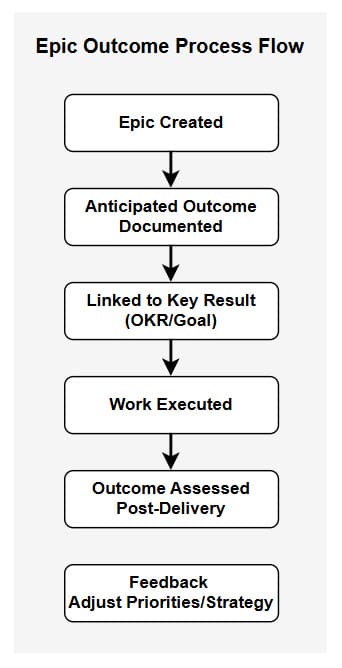
This and the book's other diagrams are shared on the figures page so they are easy to read at full size, including The Scope of Measurement and Closing the Loop from Flow to Realization.
A worked example
A team builds an in-product help center intended to deflect support tickets. The anticipated outcome, written before work starts: reduce support tickets per active user by 25 percent, measured 90 days after release. Leading signals to watch along the way: help center visits and search usage.
At the 90-day review the evidence is mixed. Help center usage is strong, but tickets per active user are down only 9 percent, and the category breakdown shows deflection working for how-to questions while billing tickets, the largest category, are untouched. That is a far more useful result than "we shipped the help center." The decision that follows might be to add billing self-service, to accept the 9 percent and stop investing, or to question whether deflection was the right goal at all. The review does not guarantee a happy answer. It guarantees an examined one.
The limits of attribution
Realization reviews produce evidence and better decisions, not causal proof. Seasonality moves numbers. Parallel initiatives land in the same window. Markets shift. Most enterprise changes cannot be cleanly A/B tested. The honest posture is directional: the outcome moved or it did not, the investment plausibly contributed or it plainly did not, and the next decision is better informed either way. Anyone promising certainty from this practice is overselling it.
Outcome realization, including the funding and economics models around it, is developed in full in Profitable Engineering: Transforming Technology Teams into Strategic Business Partners by Phil Clark. The book is available in paperback, hardcover, Kindle, and audiobook.