Engineering Economics
Engineering economics is the discipline of understanding a technology organization as an investment: what it costs, what capacity that cost buys, and what value comes back, in financial and nonfinancial terms. It is not a cost-cutting program. A profitable engineering organization is rarely the cheapest one; it is the one whose capacity reliably turns into outcomes.
From cost center to investment
Most technology organizations are still discussed through one number: technology spend as a percentage of revenue. That framing invites exactly one conversation, which is how to make the number smaller. It says nothing about what the spend produces, so quality, capability, and growth get traded away invisibly.
The alternative conversation treats the same spend as capacity: this is what we pay, this is the capacity it buys, and these are the outcomes that capacity is committed to. The number to manage stops being the cost and becomes the return.
The three working numbers
A leadership team does not need an accounting system to start; it needs three honest numbers per value stream. First, cost-to-serve: what it costs to run what already exists, including operations, licenses, and the keep-the-lights-on share of people's time. Second, capacity: how much of the organization's time is actually available for planned, outcome-committed work. Third, operational cost trend: whether running the existing estate is getting cheaper or quietly eating the investment budget. How spending is classified, including the CapEx and OpEx treatment and project-versus-product funding, shapes behavior more than most leaders expect; the book treats both in depth.
Value leakage
Value leakage is the gap between the capacity an organization pays for and the value that actually arrives. It hides in familiar places: work waiting between teams, rework from unclear requirements, features shipped but never adopted, initiatives abandoned at 80 percent done, and unplanned work that consumes the roadmap. Leakage is where engineering economics connects to Flow + Realization: flow problems create the leaks, and skipped realization reviews keep them invisible.
A small worked calculation
Take one value stream of 20 people at a fully loaded cost of $200,000 per person per year: a $4.0 million annual investment. If 25 percent of its capacity goes to unplanned work, incidents, expedites, and rework, then $1.0 million per year is buying none of the outcomes the stream was funded for. Reclaiming even five points of that capacity redirects $200,000 of annual investment back toward planned work. None of this requires precision accounting; it requires knowing roughly where the capacity goes, which most organizations have never measured.
The value stream P&L: a lens, not a ledger
The book proposes an exploratory model: viewing a single value stream with a cost side (the numbers above) and a benefit side (the financial and operational outcomes it produces), so investment decisions get made at the level where value is actually created. Two things should be said plainly. It is a management framework for better decisions, not an accounting standard; it is not GAAP, and it is not for financial reporting. And its benefit side depends on the realization practice: without examined outcomes, a value stream P&L just decorates assumptions with arithmetic.
Financial and nonfinancial outcomes
Not every outcome monetizes credibly, and forcing dollar figures onto everything destroys trust with finance faster than anything else an engineering leader can do. Reliability, security posture, customer effort, and team sustainability are real outcomes worth investing in; they should be measured honestly as what they are, with the financial translation made only where the evidence supports it.
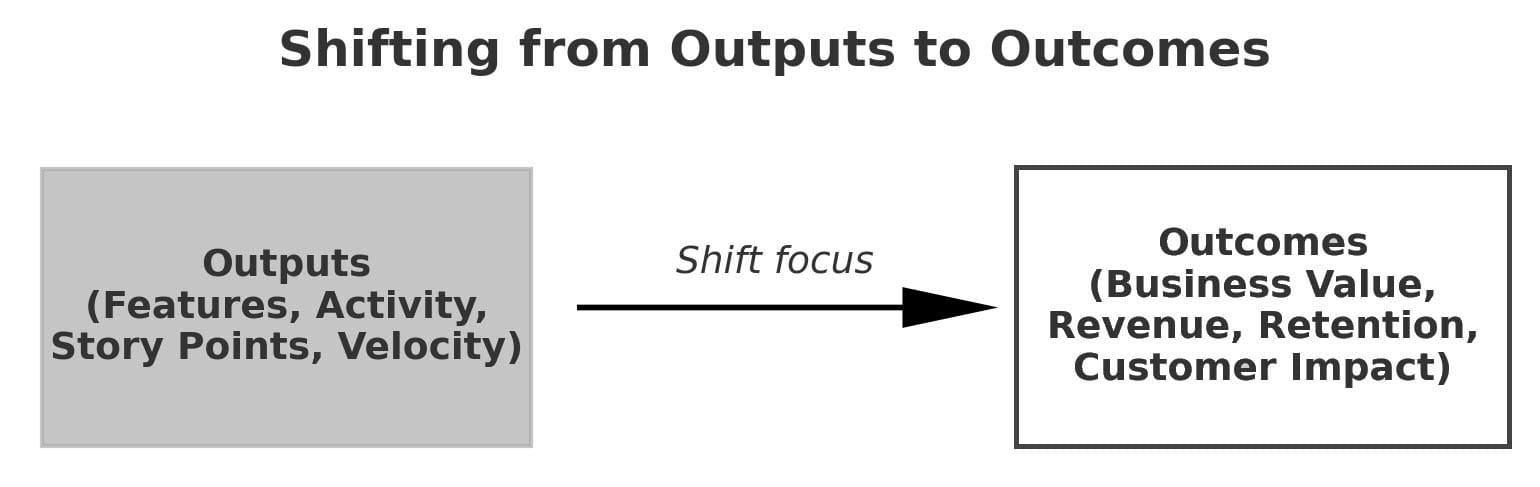
This and the book's other diagrams are shared on the figures page so they are easy to read at full size, including The CapEx vs. OpEx Trap and Project Budgeting vs. Product Funding.
Engineering economics, from funding models to the value stream P&L, is developed in full in Profitable Engineering: Transforming Technology Teams into Strategic Business Partners by Phil Clark. The book is available in paperback, hardcover, Kindle, and audiobook.